
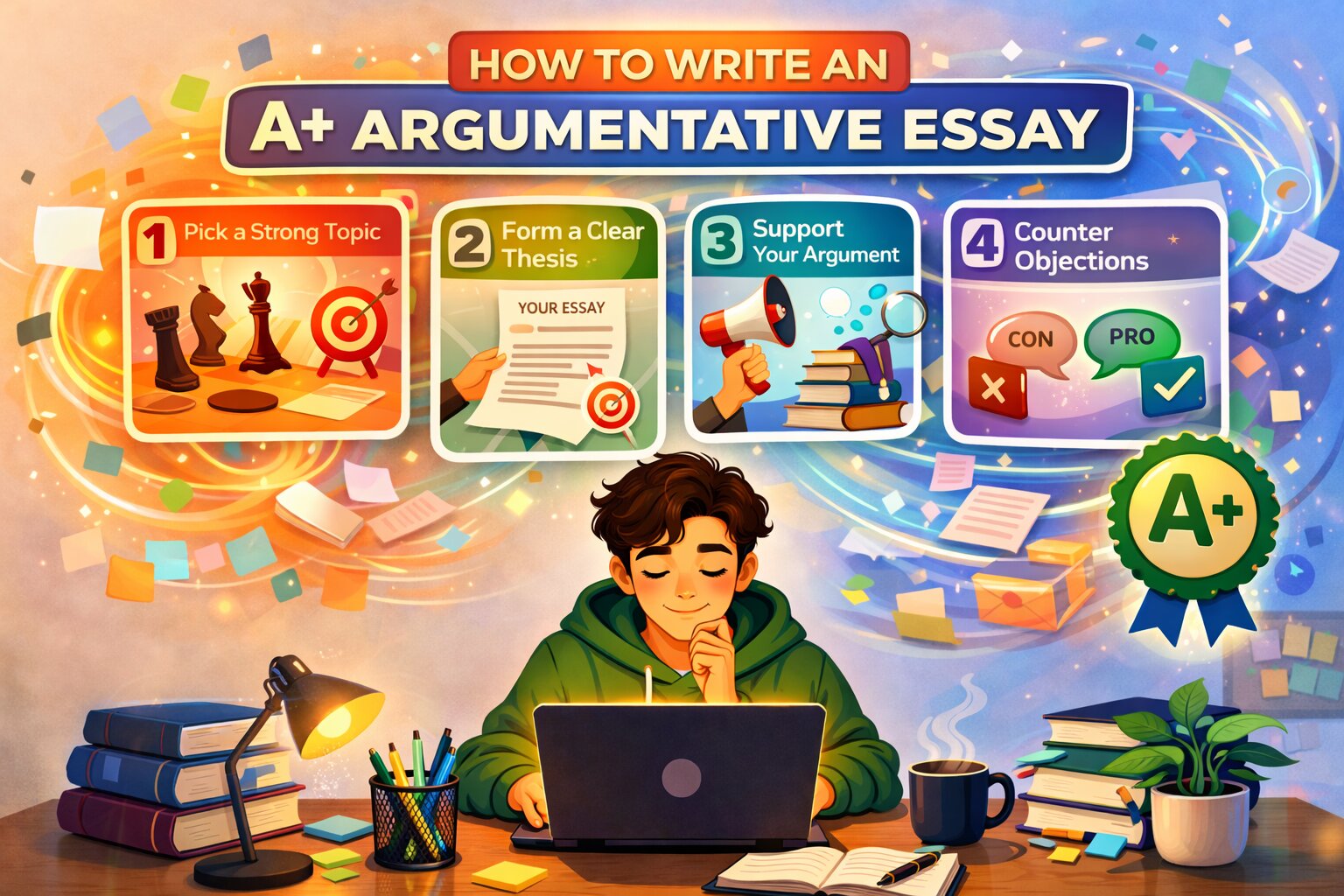
Argumentative essays remain one of the most important forms of academic writing in 2026. They test more than grammar and structure. A strong argumentative essay shows that you can think critically, take a clear position, support it with evidence, and respond intelligently to opposing views. Whether you are writing for high school, college, or university, mastering this format can improve both your grades and your confidence as a writer.
Many students make the mistake of treating an argumentative essay like a collection of opinions. That approach rarely works. An A+ essay is not about sounding passionate. It is about building a logical, persuasive case that is clear, organized, and well-supported from beginning to end.
This guide explains exactly how to write an A+ argumentative essay in 2026, with practical strategies, examples, and common mistakes to avoid.
What Is an Argumentative Essay?
An argumentative essay is a type of academic writing in which you take a position on a topic and defend it using logic, evidence, and analysis. The goal is not just to express what you think. The goal is to convince the reader that your position is stronger than the alternatives.
A good argumentative essay includes:
- a clear thesis
- strong supporting points
- credible evidence
- logical paragraph structure
- a counterargument
- a strong conclusion
In 2026, teachers and professors expect students to go beyond basic opinions. They want analysis, balance, and thoughtful argumentation.
What Makes an Argumentative Essay A+ Level?
An A+ argumentative essay usually has five qualities:
Clear position
The writer takes a definite stand and does not stay vague.
Strong structure
Each paragraph has a purpose and supports the main argument.
Solid evidence
Claims are supported with facts, examples, studies, or expert opinion.
Critical thinking
The essay does not just repeat information. It explains why the evidence matters.
Strong rebuttal
The writer addresses opposing views and shows why their own argument remains stronger.
That final point is especially important. A top essay shows that you understand the debate from more than one side.
Start by Understanding the Prompt
Before writing, read the assignment carefully. Many students lose marks because they misunderstand the task.
Look for instruction words such as:
- argue
- evaluate
- discuss
- defend
- assess
Then identify the main issue. If the topic is too broad, narrow it.
Example prompt:
Should universities allow students to use AI writing tools in academic work?
That question is already argumentative because reasonable people can disagree. Your job is to choose a clear position and defend it.
Choose a Clear and Defensible Position
A weak essay often begins with an uncertain thesis. If you sound hesitant, the argument loses force.
Weak position:
AI tools have both good and bad sides in education.
This is too general and does not take a real stand.
Strong position:
Universities should allow limited use of AI writing tools because they can improve brainstorming, support language development, and prepare students for modern professional environments.
This version is stronger because it states a clear argument and previews the main reasons.
Your reader should know exactly where you stand by the end of the introduction.
Build a Strong Thesis Statement
The thesis statement is the core of the essay. It should be specific, arguable, and focused.
A useful formula is:
Topic + Position + Main Reasons
Example:
College students should be required to take financial literacy courses because these classes improve budgeting skills, reduce debt risk, and prepare students for adult responsibilities.
This thesis works because it is direct and easy to support in the body paragraphs.
Research Smart, Not Forever
In 2026, students have access to faster research tools than ever, but more information does not automatically mean a better essay. Strong writers do not collect endless material. They gather relevant evidence that supports their argument clearly.
Look for:
- recent academic studies
- official reports
- reputable news analysis when relevant
- expert commentary
- reliable statistics
- real-world case studies
Good evidence should strengthen the argument, not overwhelm it. A few strong sources are better than many weak ones.
Use a Proven Argumentative Essay Structure
A strong structure makes your essay easier to write and easier to read. For most assignments, this format works well:
Introduction
- hook or opening context
- background on the issue
- thesis statement
Body Paragraph 1
- first main argument
- evidence
- explanation
Body Paragraph 2
- second main argument
- evidence
- explanation
Body Paragraph 3
- third main argument
- evidence
- explanation
Counterargument Paragraph
- present opposing view fairly
- explain why it seems reasonable
- rebut it with logic and evidence
Conclusion
- restate thesis
- summarize key points
- end with a strong final thought
This structure helps keep the argument focused and balanced.
Write an Introduction That Sets Up the Debate
A strong introduction should not waste time. It should quickly establish the issue and guide the reader toward your thesis.
Weak opening:
Since the beginning of time, people have had different opinions about education.
This sounds generic and weak.
Better opening:
In 2026, AI writing tools have become part of everyday student life, raising serious questions about academic integrity, fairness, and the future of learning.
This opening is relevant, modern, and directly connected to the topic.
After the opening, give brief context and end with your thesis.
Make Each Body Paragraph Argument-Driven
In an A+ essay, body paragraphs do more than present information. They actively prove the thesis.
A strong body paragraph usually includes:
- a topic sentence
- evidence
- analysis
- a linking sentence
Example:
One reason universities should allow limited AI use is that these tools can improve the writing process without replacing critical thinking. For example, students often use AI to generate outlines, clarify sentence structure, or identify grammar problems. When used responsibly, this support helps students focus more on argument quality and less on basic language errors. As a result, AI can function as an academic aid rather than an academic shortcut.
Notice that the paragraph does not just mention a point. It explains why the point matters.
Use Evidence, Then Analyze It
One of the biggest differences between average and excellent essays is analysis. Many students include evidence but fail to explain it.
Weak approach:
A study showed that students using planning tools perform better.
That statement alone is not enough.
Stronger approach:
A study showing that students perform better with planning tools supports the argument that structured assistance can improve academic outcomes. This matters because AI writing tools, when limited to planning and editing support, may function in a similar way by helping students organize ideas more effectively.
Evidence becomes powerful only when you connect it clearly to your thesis.
Include a Strong Counterargument
A real argumentative essay must acknowledge the other side. Ignoring opposing views makes your argument look incomplete.
Example counterargument:
Critics argue that allowing AI writing tools in universities may weaken independent thinking and encourage academic dishonesty.
That is a fair point. Now rebut it:
Rebuttal:
This concern is valid when AI is used to generate full assignments without student input. However, banning all AI use ignores the reality of modern education and work environments. A better solution is to teach responsible use, define clear limits, and require students to remain accountable for their final ideas and analysis.
A good rebuttal does not mock the other side. It addresses it seriously and responds logically.
Keep Your Tone Confident and Academic
Argumentative writing should sound confident, but not emotional or aggressive.
Avoid:
- exaggerated claims
- personal attacks
- dramatic language
- unsupported certainty
Weak tone:
Anyone who disagrees clearly does not understand how education works.
Better tone:
Although some critics believe AI tools undermine academic integrity, this concern becomes less convincing when universities establish clear usage guidelines.
This sounds more intelligent and persuasive.
Use Clear Language Instead of Forced Complexity
In 2026, strong academic writing still values clarity over inflated wording. Trying too hard to sound advanced often weakens the essay.
Weak version:
The institutional prohibition of algorithmically assisted textual production mechanisms constitutes an impractical pedagogical constraint.
Better version:
Banning AI writing tools completely is impractical in modern education.
Simple, precise language is usually more convincing.
Common Mistakes in Argumentative Essays
Many students lose marks for the same reasons.
No clear thesis
Without a strong position, the essay feels unfocused.
Weak evidence
Claims without proof are not persuasive.
Listing points without analysis
Do not just present facts. Explain them.
Ignoring counterarguments
A one-sided essay feels incomplete.
Poor structure
Random paragraph order weakens logic.
Overly emotional writing
Argumentative essays need reason, not outrage.
Repetition
Each paragraph should add something new.
Avoiding these mistakes can improve your grade immediately.
Example of a Strong Argument Flow
Imagine the topic is: Should college education be free?
A strong argument flow could look like this:
Introduction: Present the issue of rising tuition and state your position.
Paragraph 1: Free college increases access for low-income students.
Paragraph 2: It strengthens the economy by creating a more educated workforce.
Paragraph 3: It reduces long-term student debt and financial inequality.
Counterargument: Critics say free college would increase tax burdens and reduce quality.
Rebuttal: These risks can be managed through targeted funding models and policy design.
Conclusion: Reaffirm why the benefits outweigh the drawbacks.
This creates a logical, persuasive progression.
Edit for Strength, Not Just Grammar
Revision is where good essays become excellent. Do not only check spelling and punctuation. Edit for argument quality.
Ask:
- Is my thesis clear and specific?
- Does each paragraph support the thesis?
- Is my evidence credible?
- Have I explained why the evidence matters?
- Is the counterargument fair and well answered?
- Does the conclusion feel strong?
Read the essay aloud. If a sentence sounds awkward or weak, improve it.
Use AI Tools Carefully in 2026
AI tools are now common in academic life, but using them carelessly can harm both quality and credibility. In argumentative essays especially, original reasoning matters.
Useful ways to use AI:
- brainstorming topic angles
- generating outline ideas
- improving grammar
- checking clarity
Unhelpful ways:
- copying generic arguments
- using machine-written paragraphs without revision
- relying on AI instead of research and analysis
A top essay should still sound like a thoughtful student, not a template.
Final Checklist for an A+ Argumentative Essay
Before submitting, make sure your essay has:
- a clear and arguable thesis
- logical structure
- focused body paragraphs
- strong evidence
- analysis after each example
- a real counterargument and rebuttal
- clear transitions
- formal but natural tone
- a strong conclusion
- careful proofreading
These elements separate average essays from top-level ones.
Conclusion
Learning how to write an A+ argumentative essay in 2026 means learning how to think clearly, argue logically, and write with purpose. A strong argumentative essay does not depend on complicated vocabulary or dramatic opinions. It depends on structure, evidence, analysis, and confidence.
When you choose a clear position, support it with strong reasoning, respond to opposing views, and revise carefully, your essay becomes far more persuasive and professional.
In 2026, the best argumentative essays are not the loudest. They are the clearest, smartest, and most convincing.